Introduction
Research Topic & Significance
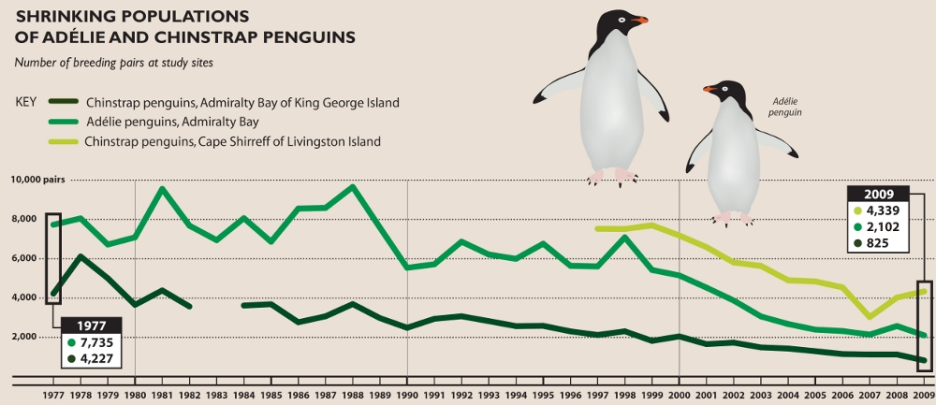
Climate change is rapidly altering habitats and food availability in the Antarctic. Among the species impacted, penguins are highly sensitive to these changes, as their life cycles are tightly coupled with changes in sea ice, snow cover, and temperature. Monitoring their populations can reveal underlying environmental shifts, meaning that changes in their populations often reflect broader ecological shifts within the Southern Ocean ecosystem. Understanding these patterns is crucial because penguins occupy a central position in Antarctic food webs, linking krill, fish, and higher predators. Declines or expansions in penguin colonies can therefore signal disruptions in marine productivity and climate stability. This research focuses on using data mining techniques to detect patterns in penguin population changes over time and space. By integrating biological and climatic datasets, we can better predict future ecological outcomes.
Stakeholders
This information is critical for stakeholders involved in environmental management, including organizations such as the British Antarctic Survey and international conservation groups. Accurate and timely data allows these stakeholders to better understand environmental changes and make informed decisions about conservation strategies. Satellite observations combined with on-ground monitoring provide rich and reliable data sources that enable dynamic and continuous analysis of environmental patterns. Our study highlights the importance of using these datasets not only for scientific discovery but also for informing real-world conservation efforts. By visualizing spatio-temporal changes in environmental conditions, we aim to make complex data easier to interpret and more actionable for policymakers, researchers, and conservation practitioners. Ultimately, these insights can support more effective planning and protection of vulnerable ecosystems in Antarctica.
Existing Solutions and Gaps
Current approaches to monitoring penguin populations rely on long-term field surveys, colony counts, and satellite observations to track population trends and assess conservation status. These methods have generated valuable datasets; for example, long-term count data combined with statistical models have revealed significant spatial and temporal variation in African penguin population declines (Sherley et al., 2020). Similarly, climate-driven demographic models have been used to project emperor penguin population dynamics by linking colony-level demographic data with sea ice conditions and climate projections (Jenouvrier 2014). However, many studies rely on data from a limited number of well-monitored colonies and must extrapolate findings to broader regions, introducing uncertainty in global population estimates (Jenouvrier, 2014). In addition, traditional monitoring approaches often analyze population data separately from environmental drivers such as climate variability and sea ice changes. Integrating ecological observations with environmental datasets and advanced spatio-temporal analytics can help uncover deeper patterns and improve conservation planning for penguin populations.
Blueprint for Your Project
This project will explore how penguin populations have changed over time and across different regions of Antarctica using data mining methodologies. A few datasets the team utilize are Climate Data Online API, British Antarctic Survey API, Antarctic Penguin Population Database, and Antarctic Sea Ice Extent databases. The project will emphasize data cleaning, integration, and exploratory analysis as foundational steps. Visualization techniques will be used to communicate spatio-temporal patterns clearly and effectively. Clustering and trend detection methods may help identify regions experiencing similar ecological pressures. Predictive modeling may be explored to estimate future population trajectories under different climate scenarios. The analysis will be iterative, allowing insights from one stage to inform refinements in later stages. Overall, the blueprint balances technical rigor with interpretability and relevance.
Implications
In the long term, this work contributes to the global understanding of how climate change reshapes ecosystems and affects biodiversity. By analyzing environmental data and ecological patterns, researchers can better understand how species respond to changing climate conditions over time. Making spatio-temporal shifts visible and interpretable allows complex environmental data to be more accessible to scientists, policymakers, and conservation organizations. This project aims to transform raw data into meaningful insights that can support evidence-based decision making. These insights can guide conservation strategies, resource management, and long-term environmental monitoring. Ultimately, protecting penguin populations helps safeguard the resilience and stability of the broader Antarctic ecosystem as a whole.
Reference Papers
Sherley, Richard B., et al. "The conservation status and population decline of the African penguin deconstructed in space and time." Ecology and Evolution 10.15 (2020): 8506-8516.
Jenouvrier, S., Holland, M., Stroeve, J., Serreze, M., Barbraud, C., Weimerskirch, H., & Caswell, H. (2014). Projected continent-wide declines of the emperor penguin under climate change. Nature Climate Change, 4(8), 715-718.